Non-decaying particle interactions
We have discovered particle-particle interactions that have distance-independent strength. These are rare in physics because most interactions weaken with separation:
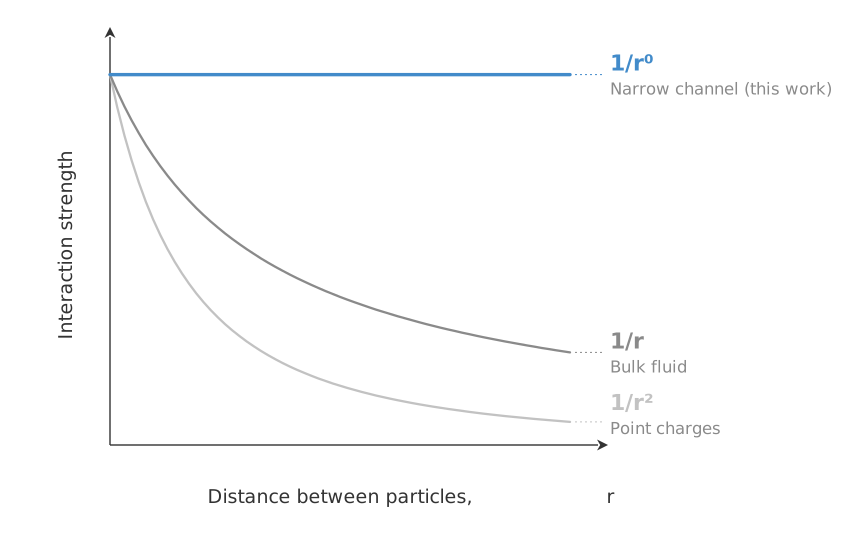
Fig. 1. How interaction strength falls off with separation (schematic). Two point charges push on each other through a field that spreads out over a sphere. The sphere’s area grows as 4πr², so the same flux is diluted over ever more surface and the force weakens as 1/r². A particle moving through bulk water instead drags fluid along with it, and that disturbance carries momentum rather than field lines: a point force in a viscous liquid sets up a flow that decays only as 1/r, so particles in water feel each other much further away than charges do. Inside a narrow channel the fluid has nowhere to spread sideways. Mass conservation forces the whole column of liquid to move together, so the coupling between two particles no longer weakens with distance at all.
An excerpt from a comment in Nature Physics by Mark Buchanan:
These somewhat surprising results, the authors show, follow from simple theory. Imagine that one particle moves, stirring up a fluid flow. Some of the fluid will flow back past the particle, moving around its sides. Poiseuille’s law implies that the increase in pressure on the particle should be proportional to the channel length, and inversely proportional to the fourth power of its width. Another relation among these quantities comes from mass conservation around the moving sphere, and a third from elementary lubrication theory, which predicts the flow of a viscous liquid at a given pressure given a minimum gap width. Putting these relations together, the authors derive a formula for the mean flow in the channel, as it depends on channel width R and length L. Significantly, the simple 1/L dependence of the flow — and hence on the force between two particles, independent of the distance between them — drops out, in perfect agreement with the experiments.
Misiunas and colleagues speculate that biology probably already exploits this effect in enhancing biochemical control over the extended distances of whole cells. For example, myriad processes within cells require molecular diffusive transport through narrow channels. Such diffusion, they argue, occurs about 40% faster than it otherwise would as a result of the long-distance flows. It’s surprising that such a simple effect could have gone undetected for so long. We typically think of geometric confinement as a restriction, yet, paradoxically, it can also be a resource.
Below is a microscopy video from our experiments. We place two particles inside a narrow channel filled with water, and move them into position with holographic optical tweezers. The video shows two cases side by side: on the left, the particles are inside a sealed channel, which does not allow the liquid to escape. On the right, they are in an open channel, where water is free to move along the column. The Brownian motion on the right is highly correlated, which suggests a long-ranged interaction between them. We measured that this interaction is constant once the particles are separated by more than one full diameter, and does not decay any further.
Published in Physical Review Letters 115, 2015 (arxiv copy).
on
Revised on